

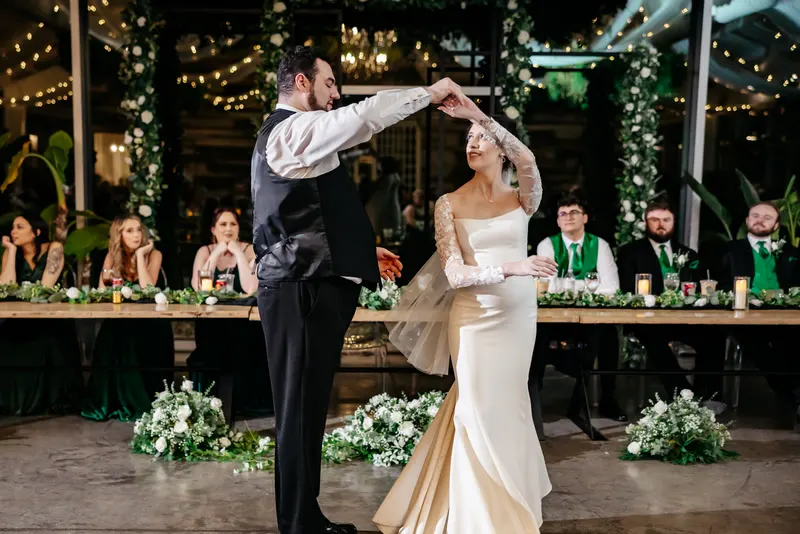
The ceremony is between the vine rows at four. By the time the couple walk out for portraits the sun is low over the hills and everything is gold. Then you follow them into a white marquee strung with festoon lights, the DJ kicks in, and the light goes from soft amber to hard tungsten in about ten minutes. Back at your desk, the portraits have orange skin, the vines look neon, the paddocks in the background have gone brown, and the reception photos are yellow from corner to corner.
Country and vineyard weddings in the Hunter Valley in New South Wales and the Yarra Valley in Victoria give you some of the prettiest light of the year. They also give you some of the hardest grades. Here is how we approach them.
Golden hour without orange skin
Golden hour is the reason couples book a vineyard. The danger is that the warmth that looks right on the hills looks wrong on a face.
The approach:
- Set white balance for the skin. Use a face, not the sky, as the reference. If the sky then looks a little cooler than you remember, warm it on its own.
- Pull orange and yellow on skin. In the HSL panel, or better with a person mask, lower orange saturation a touch and lift its luminance. Faces stay warm but stop glowing.
- Watch backlight. With the sun behind the couple, haze lifts the blacks and washes out contrast. Bring some back, but not so much that the soft feel disappears.
- Hold the highlights in the sky and the dress. Low sun still clips, especially on white fabric.
The result should feel like warm late light, with skin that still looks like skin.
Timing matters too. Country golden hour moves quickly once the sun drops behind a ridge. The first portraits can be warm and bright, the last ones blue and soft, ten minutes apart. Grade the sequence as a run rather than frame by frame, so the change in light reads as the evening coming on rather than as an editing jump. Where a frame sits between two scenes, we grade it towards whichever set it will appear beside in the gallery.
Vine greens and dry paddocks
Australian country greens are not European greens. Depending on the season, vine rows can be bright and full or patchy, and the paddocks behind them can be anything from soft green to dry gold.
Push global saturation to make it look “lush” and the vines go neon while the dry grass turns a muddy brown. Instead:
- Shift greens slightly towards yellow and lower their saturation, so vines look natural rather than artificial.
- Leave dry grass gold. It’s part of the place, and couples who chose a country wedding usually want it to look like the country.
- Check the dress against the greens. Strong green surroundings bounce colour onto white fabric and skin. A small magenta correction on the dress alone fixes it.
Dust, haze and the drive in
Country weddings often mean gravel roads, dry ground and a breeze. That brings dust onto lenses and sensors, and haze into backlit frames.
Sensor spots are worth checking with visualise spots in Lightroom, because the same spot appears in every frame from that lens until it’s cleaned. We sync spot removal across the affected frames rather than fixing them one by one. Haze in backlit shots is handled in the grade with dehaze used lightly, because heavy dehaze darkens skin and adds crunch.
Marquee and festoon light at night
The reception is usually where a vineyard gallery falls apart. A white marquee lit by festoon bulbs, sometimes with uplights and a dance floor, gives you:
- A strong tungsten cast on skin and canvas.
- Bright bulbs against a dark roof.
- Noise in the corners and on the dance floor.
- Mixed colour if the DJ brings coloured lights.
We treat the marquee as its own scene. White balance is corrected for skin, while the bulbs stay warm, because warm bulbs are part of the feel. The canvas should look white or soft cream, not yellow and not grey. Noise is reduced where it shows, without smoothing faces into plastic. If flash was used, flash and ambient are balanced so faces don’t look lit from a different room.
Then the marquee is matched back to the ceremony and portraits, so that across the gallery the couple look like the same people in the same day.
Matching stills and film
If your studio shoots both, or you work alongside a videographer, a vineyard wedding is where a shared grade matters most. Golden hour and festoon light are both easy to get slightly different between stills and video, and couples notice when the film looks warmer than the photos.
Our Gallery + Film packages edit both side by side, with one grade across stills and film:
| Package | What’s included | Price |
|---|---|---|
| Essential | Wedding gallery, 300 to 500 images, plus a 5 to 8 minute highlight film | A$225 |
| Signature | Wedding gallery plus a 15 to 40 minute feature film and 1-minute teaser | A$300 |
| Complete | Wedding gallery, highlight film and feature film | A$450 |
On the film side, every camera is matched before the cut, including drone footage over the vines, and speeches in the marquee are cleaned up so they stay clear over the room noise.
What to send
With a vineyard or country wedding, the brief is where you tell us what the day should feel like:
- Your preset, plus three to five finished frames from a similar wedding.
- How warm you like golden hour, and how warm you like the marquee.
- Whether you prefer the dry country look or a greener one.
- For films, the music and must-have moments.
Paste a Dropbox, Google Drive, WeTransfer, pCloud or Box link. Standard turnaround is 7 business days from the moment the link works and the brief is complete, with weekends and Australian public holidays not counted. Our team in Pakistan is five to six hours behind Sydney and Melbourne, and the team works in shifts around the clock, so a link is picked up soon after it arrives and questions about the brief can come back at any hour.
Try a country wedding free
Your first Gallery or Highlight project is free, with no card. Send a vineyard wedding with the evening included, because the marquee is the part that tells you most about an editor.
Shooting around Sydney? Read the Sydney wedding editing guide, or the Melbourne guide for the Yarra Valley.