

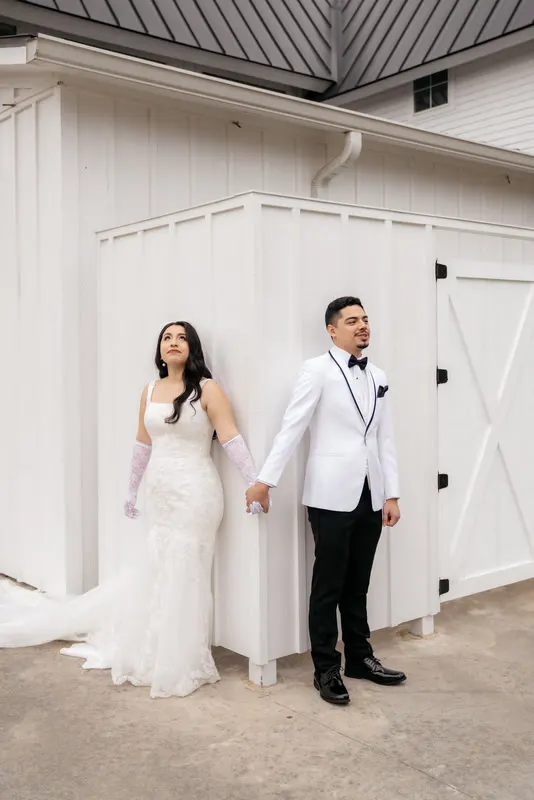
You drove out past Wendover, the couple got their first look, the dress looked incredible against all that white and the light was everything you hoped for. Then you opened the raws. Half the frames have a blown dress and gray faces. In the other half, the salt is blue near the couple and creamy at the horizon. And no two frames in a row match.
That is the normal result of a Bonneville Salt Flats session, not a sign you shot it badly. Here is why the salt is hard, and an editing approach that holds a whole bridals set together.
Why the salt flats are so hard to edit
The salt is a giant reflector with no shade. Photographer Sal Cincotta, in a Westcott U lesson shot there, describes the “severe reflection of white light” off the ground. His answer on location was to light faces with a strobe and use the sun as a hair light.
That reflection causes three separate problems in post:
| Problem | What you see in the raws | Why it happens |
|---|---|---|
| White on white | Dress and salt merge, no lace or fold detail | Both are near the top of the histogram |
| Flat, gray faces | Skin looks dull even when exposure is right | Light from below fills every shadow, so faces lose shape |
| Shifting salt color | Salt goes blue in shade, cream in sun, gray at midday | The salt reflects whatever light hits it, including blue sky |
Each one needs its own fix. A single preset dropped onto the set will usually fix one problem and make another worse.
Holding dress detail against the salt
Start in camera if you can. Expose for the dress, not the faces. You can lift a face by a stop in Lightroom much more cleanly than you can rebuild lace that clipped to pure white.
In Lightroom Classic:
- Check for clipping first. Turn on the highlight clipping warning (press J). Anything flashing red on the dress is gone and no slider brings it back.
- Pull Whites before Highlights. Bring Whites down until the dress stops clipping, then use Highlights to recover the folds. Pulling Highlights alone tends to make white fabric gray.
- Mask the dress. Use Select Subject, then subtract the skin with a brush, or use a luminance range mask on the brightest tones. On that mask, add a small Texture lift (+10 to +20) and a touch of negative Highlights. This brings back fabric detail without adding crunch to skin or the salt.
- Go easy on global contrast. Adding contrast to a white-on-white frame pushes the dress and salt toward the same white. Build contrast on the couple with masks instead.
If you used flash, the dress will often be the brightest thing in the frame. If you didn’t, the salt usually is. Sort the set by that before you edit, because the two groups need different starting points.
Keeping the salt neutral across a session
The salt shifts color because it is reflecting light. In full sun it reads close to neutral. In shadow, including the shadow your couple casts, it reflects the blue sky. Late in the day it goes warm.
A reliable order:
- Set white balance from sunlit salt. Use the eyedropper on a patch of salt in direct light, away from the couple. That gives you a neutral base.
- Fix shadowed salt locally. Paint or mask the shadowed areas and warm them a little, or pull Blue saturation down inside that mask only. Warming the whole frame to fix the shadows turns the sunlit salt yellow.
- Watch the Blue and Aqua sliders. In HSL, a small drop in Blue saturation calms the salt without touching the sky much. If the sky goes dull, mask the sky separately.
- Sync in groups, not across the whole set. Group frames by the direction the couple faces relative to the sun. Edit one frame per group, sync to that group, then compare groups side by side in Survey view (N).
The goal is not perfectly white salt in every frame. It is salt that looks like the same place from the first frame to the last.
Faces that look flat or gray
Bounced light from the ground fills every shadow, so faces lose depth. Exposure is often fine; the face just has no shape.
- Use Select People (Lightroom Classic’s people masks) and lift Exposure slightly on face and skin only.
- Add a small amount of negative Highlights and positive Shadows to the face mask, then a little Contrast back. This rebuilds shape that the reflected light removed.
- If skin reads gray or cool, warm the face mask slightly instead of the whole frame.
- Squinting is common in this light. Choose those frames in the cull rather than trying to fix them in the edit.
Sunrise, sunset and the wet season
Wandering Weddings recommends sunrise and sunset for the salt flats, and the editing makes the reason clear. Low sun gives you directional light, shadows with shape and salt that already has a little warmth, so the white-on-white problem is milder.
Midday sessions need the most work. Expect the full process above on nearly every frame.
The flats also change through the year. The BLM and Wandering Weddings both note seasonal standing water in spring, with the ground usually dry in summer and fall. A wet session gives you mirror reflections, which brings two extra edits:
- Straighten the horizon precisely. A tilted horizon is much more obvious when the sky is mirrored below it.
- Grade the reflection with the sky. A reflection that is a different color from the sky looks like a composite. Mask both and keep them close.
Permits: check with the BLM
The Bureau of Land Management says photography at the Bonneville Salt Flats needs a special recreation or film permit, issued through the BLM Salt Lake Field Office. Rules and fees change, so check the BLM page before you book a session. We edit photos, we don’t arrange permits, and we’d rather you hear the current rules from the BLM than from us.
When to send a salt flats session to an editor
The process above works. It is also slow, because nearly every frame needs local masks and the groups need matching against each other. On a bridals session that comes back as 150 images, that can be an evening or two you don’t have in May.
That is where we fit. A bridals session usually goes in our Engagement gallery: $50 for 100–200 culled and graded images from up to 1,000 raws, 2 revisions, back in 7 business days. You send three frames you have already edited and your preset. We match your look, including how warm or neutral you like your salt, and return the gallery with the Lightroom catalog so you can adjust anything yourself. If you also shot the wedding, we grade the wedding gallery from the same references, so the two match in the album.
See how we hold white detail in the white barn wedding gallery and backlit portraits in the hilltop terrace wedding.
Try it on your next bridals session
- Start free: your first project is free, any Gallery tier or the Highlight film, no card. Start your free trial.
- See what’s included: what we edit and packages.
- Read the Utah guide: wedding photo and film editing for Utah photographers.
- Shooting more sessions for the same couple? Read one style across bridals, formals and the wedding, and for desert sessions, red rock skin tones.