

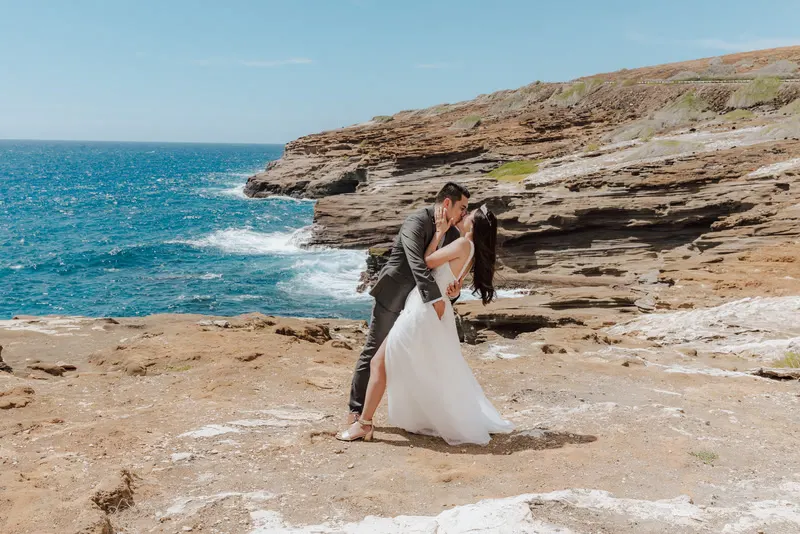
The ceremony was at noon on a terrace above the caldera. The couple looked wonderful, the guests squinted, and the camera recorded the whitewashed wall behind them as a solid white rectangle. Back home, the sea in every portrait is a slightly different blue, and none of them is quite the blue you remember.
Santorini and the Amalfi Coast give you some of the most striking backdrops in Europe and some of the least forgiving light. Here is how to edit them so the gallery looks bright and clean rather than burnt and cold.
Why these two places come up so often
Greece and Italy sit at the top of the list for many English-speaking couples. Bridebook’s UK Wedding Report 2026 found that among UK couples who considered a European wedding abroad, Italy was considered by 21% and Greece by 20% (reported by Travel Radar). ENIT’s 2022 figures, reported by The Local Italy, put Campania, home of the Amalfi Coast, among the top regions for foreign couples marrying in Italy.
Both places share the same raw material: white or pale walls, a lot of sky, a lot of sea, and ceremonies that are often booked in the middle of the day.
Highlight recovery on white
Whitewash, limestone and white stucco are the first thing to go in hard sun. The order of work matters:
- Highlights and whites down first. See how much detail is actually there before you touch exposure.
- Exposure for skin. Once the whites are held, set exposure so faces look like faces in daylight.
- Accept what cannot be recovered. If a wall is clipped in all three channels, there is no texture to bring back. Pulling it down only makes it grey. Keep it clean and even so it reads as bright white rather than damaged.
- Check the dress separately. A white dress and a white wall rarely clip at the same point. A local mask on the dress lets you keep lace detail without darkening the building.
Rangefinder’s guide to shooting in harsh midday sun suggests backlighting the couple and finding open shade. If you shot that way, the edit becomes lifting faces out of the backlight while keeping a soft glow on the edges, rather than rescuing frontal hard light.
One thing that helps the edit more than any slider happens on the day. If you can expose a third to two thirds of a stop under for the whites on a bright terrace, you keep detail in the walls and the dress, and lifting skin in Lightroom costs very little. Recovering a clipped wall costs everything. If your style is bright and airy, that is still the safer route: the brightness goes back in during the grade, where you control it frame by frame.
For the couple’s portraits on white steps or against a white wall, also watch the edges of the frame. Bright surfaces at the edge pull the eye out of the picture. A gentle radial or edge burn keeps attention on the people without the vignette becoming visible.
Keeping blue sea blue, not cyan
The Aegean and the Tyrrhenian are both very blue, but cameras tend to record bright water with too much aqua. Push saturation for drama and the sea goes cyan; leave it alone and it can look flat.
What tends to work:
- Lower aqua saturation and shift the aqua hue slightly towards blue.
- Treat sky and sea as separate. A blue sky pushed towards deep blue while the sea stays aqua looks like two photos stitched together.
- Watch blue doors and painted shutters. They are the strongest blues in a Santorini frame and the first to oversaturate.
- Check consistency across the set, not just in your favourite frame. A sea that shifts colour between portraits is one of the most visible inconsistencies in a destination gallery.
Skin in reflected light
White walls work as huge reflectors. That is often why the faces look decent even in noon sun, but the light bouncing off them takes on whatever colour is around: cool from the sea and sky, warm from terracotta and sand.
Look for:
- A cool or grey cast on faces shot facing the sea. Warm them locally rather than warming the whole frame.
- Shiny skin. Heat and sun mean highlights on foreheads and noses. Our galleries include skin clean-up on close portraits; heavy retouching across many frames is quoted separately.
- Guests in mixed light. Half a row in shade and half in sun is common on terraces. Even them out enough that the row reads as one group.
Sunset portraits versus the ceremony
On these coasts the portraits often happen at sunset and the ceremony at midday, so the two most important scenes are graded in opposite directions. The Wed’s golden hour guide notes that the light shifts from yellow to orange to blue within roughly 30 to 45 minutes.
Grade the ceremony as your anchor, then let the sunset be warmer without letting skin drift far from the ceremony skin. Couples accept, and expect, an orange sky at sunset. They notice when their faces look like they belong to a different wedding.
Drone over the caldera or the coast
Clifftop venues almost always come with drone footage, either from you or from your filmmaker. In a film, the drone shots often open the story, so they need the same blue sea as the ground footage.
Our Highlight film is €90 and includes up to three cameras plus drone, delivered from 480p to 4K, cut to the music you choose, with the project file and two revisions. If you only want the aerials cut on their own, the Drone-only edit add-on is €25 for a short aerial film. Our clifftop beach wedding film shows how backlit sunset portraits and coastline drone shots were handled in a real project.
Turnaround when the couple has flown home
Destination couples usually want something to share soon after they get back. You have three practical options:
| Option | What it gives you |
|---|---|
| Standard delivery | Seven business days from when your link works and the brief is complete |
| Rush | 72 hours, +50% on the whole order |
| Sneak peek from you | A handful of frames you edit yourself while the full set is with us |
Our editing team is in Pakistan, on UTC+5 all year. That is two hours ahead of Greece in summer and three in winter, and three to four hours ahead of Central Europe. The time difference does not shorten or lengthen the delivery date; business days are counted from when the link works, and weekends and public holidays in your country are not counted.
Your next step
If you have a Santorini or Amalfi set waiting, send it as your trial.
- Start the free trial: your first Gallery project or Highlight film is free.
- See prices and add-ons, including Rush and the Drone-only edit, on packages.
- Follow the timeline on how it works, and see every shoot type in what we edit.
- Browse our work and the FAQ.
- Read how we handle your couples’ images in our data processing terms and on our confidentiality page.
For more on Greek weddings, read our Greece wedding editing guide. For the Italian side of the coast, see grading Tuscany and Lake Como light.