

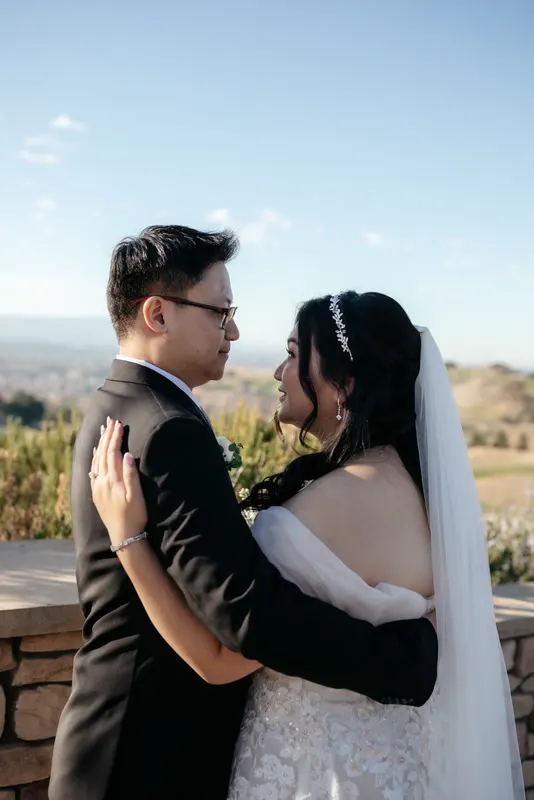
You shot welcome drinks on a terrace at dusk, a ceremony at one o’clock in full sun, portraits in the last half hour of light and a party that ran until the DJ was asked to stop. Four scenes, four colour temperatures, sometimes two venues. Your couple will flip through the gallery in one sitting and expect it to look like one wedding.
That is the real editing problem with a destination weekend in Europe. It is not any single difficult frame. It is making very different light belong to the same story.
Why destination weekends break your preset
Most presets are built on the work a photographer shoots most. If that is soft light in Ireland, the Netherlands or northern Germany, the preset expects gentle contrast and forgiving highlights. Drop it onto a Puglia courtyard at 1 pm and the whites clip, the shadows go hard and skin turns either orange or grey depending on what was bouncing off the walls.
A destination wedding also tends to stack scenes you would normally shoot on different days:
| Scene | Typical light | What goes wrong in the edit |
|---|---|---|
| Welcome drinks | Dusk, then string lights | Blue sky behind warm faces, white balance pulled both ways |
| Ceremony | Midday sun, open shade if you are lucky | Clipped whites, squinting, hard shadows under eyes |
| Portraits | Golden hour, then blue hour | Colour shifts within minutes |
| Reception and party | Tungsten, LED uplights, flash | Coloured casts on skin, noise, mixed sources |
Each row needs its own adjustments. The job is to make those adjustments without the gallery jumping every time the scene changes.
Midday sun: hold the whites, find the faces
Hard sun is the scene most likely to be the ceremony, so it often becomes your anchor. Rangefinder’s guide to shooting in harsh midday sun recommends backlighting the couple and using open shade where you can. If you did that on the day, the edit is about keeping the backlight from washing out and lifting faces without making them look lit by a phone screen.
What helps in the grade:
- Pull highlights first, then set exposure for skin. White dresses, limestone and whitewashed walls need detail, not a flat white patch.
- Bring shadows up gently. Hard sun casts dark eye sockets, and the fix is local, not a global shadow slider at +80.
- Watch saturation in the background. Bougainvillea, sea and sky all get louder as you lift exposure.
- Check the guests, not just the couple. Squinting guests in the second row are often the frames that look most “edited” when they are pushed too far.
Golden hour moves faster than your white balance
The Wed’s golden hour guide puts the window at roughly 30 to 45 minutes, with white balance swinging from yellow to orange to blue over that time. If you shot 400 frames in that window, a single white balance setting will look right on maybe a third of them.
The cleaner way to grade it:
- Sort the portrait session by capture time.
- Pick three reference frames: early, middle and late.
- Grade those three so skin matches across them, even though the background warmth changes.
- Sync each reference to the frames nearest it in time, then check the transitions.
Let the sky change. People expect sunset to look different from the start of the session. What they notice is skin that changes colour from one frame to the next.
Night parties: keep it a party, keep skin human
Reception light in a villa, a masseria or a beach club is rarely one source. You will have tungsten in the dining room, festoons outside, LED uplights in whatever colour the planner chose, and your own flash on top.
Some ground rules for the night set:
- Set white balance for skin under the main light, then deal with coloured spill using HSL or a local mask rather than fighting it globally.
- Keep a bit of the venue colour. A purple uplit dance floor graded to neutral grey looks wrong to the couple who were there.
- Match flash frames and ambient frames so the dancing does not alternate between two looks.
- Reduce noise on high-ISO frames before you add grain, if your style uses grain.
Grade the weekend as one set
On our European page the line is “destination work across several days is graded as one set”. In practice that means the order of work matters more than any single slider.
The order we work in on a multi-day gallery:
- Match your style first. Test frames from each scene are graded against your preset and your three reference frames, and checked side by side.
- Choose an anchor. Usually the ceremony, because it carries the most important frames.
- Match skin across scenes. Skin is what your couple and their families look at. If it holds, the backgrounds can move.
- Match whites. Dress, shirts and table linen should read as the same white from dusk drinks to the dance floor.
- Final pass in grid view. The whole set at thumbnail size shows jumps that are invisible when you look frame by frame. This is the quality check step on our timeline.
If you send the full card, the cull happens before the grade: best expression, sharp focus, no near-duplicates, down to the count in your package. A Wedding gallery is 300 to 500 images from up to 3,000 raws, counted across the whole wedding, all days together. A long or multi-day weekend is charged at the same package price; just list the days and scenes in the brief.
Stills and film in the same grade
If your studio shoots both, or you work with a filmmaker on the same weekend, the gallery and the film are often graded by different people weeks apart. The couple then sees warm, creamy portraits next to a cooler, contrastier film, and it feels like two weddings.
Our Gallery + Film packages handle both in one project. Test stills and a test clip are graded to your references first, so the gallery and the film share a starting point. Near the end, the film colour is checked side by side with the gallery before delivery.
| Package | What is in it | Price |
|---|---|---|
| Essential | Wedding gallery (300–500 images) + Highlight film (5–8 minutes) | €135 |
| Signature | Wedding gallery + Feature film (15–40 minutes) + 1-minute teaser | €180 |
| Complete | Wedding gallery + Highlight + Feature + teaser | €270 |
All three come back in one delivery with both project files, in seven business days from when your link works and the brief is complete. Rush is 72 hours for +50% on the whole order.
About the time difference
Our editing team is in Pakistan, which stays on UTC+5 all year with no clock change. That puts us four hours ahead of Central European time in winter and three hours ahead in summer. For Ireland and Portugal the gap is five and four hours; for Greece it is three and two.
It does not change the deadline. Delivery is counted in business days from when your link works and the brief is complete, and weekends and public holidays in your country are not counted. And because the editing team works in shifts around the clock, a link is picked up soon after it arrives, and questions about a brief can come back at any hour, whatever the time difference.
Your next step
If you have a destination weekend on a card right now, the simplest test is to send it.
- Start with the free trial: your first Gallery project or Highlight film is free, edited and delivered like a paid one.
- Compare prices on packages, all fixed in euros.
- See the day-by-day plan on how it works, and the shoot types we take on in what we edit.
- Look at a sunlit terrace set in our work, or browse all projects.
- Read how we handle your couples’ images in our data processing terms and our confidentiality page, and find the rest in the FAQ.
If your next wedding is in Italy, the Italy editing guide and our post on grading Tuscany and Lake Como light go further into that light.