

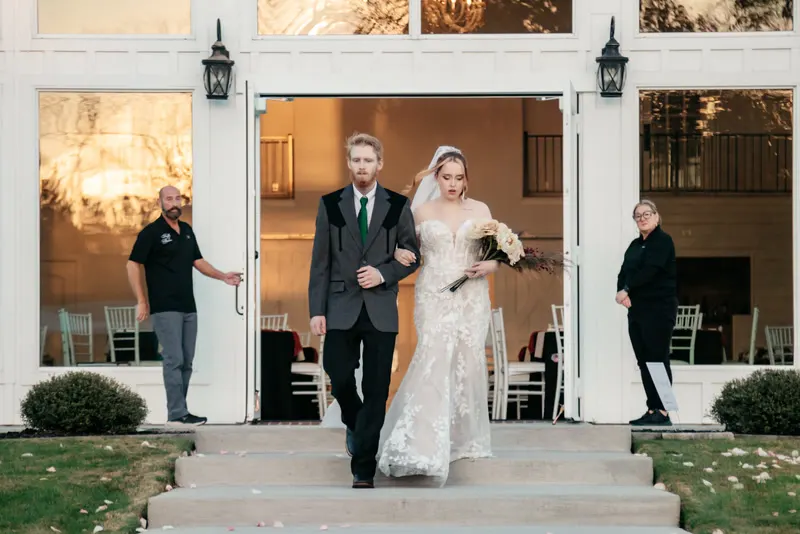
The bride’s father gave his speech in Italian. The best man spoke in English. The vows were in both, switching mid-sentence, and the grandmother’s toast was in a dialect half the guests did not follow. Now someone has to cut a highlight film around those words, and pick the three lines that will make the couple cry in the right way.
If you film destination weddings in Europe, this is normal. The question is how an outsourced editor can cut it well, and what you need to give them.
Why the language matters less than you think
Most of a wedding film does not depend on understanding every word. A full-length film keeps the speeches whole, so nothing is cut out of the middle of a sentence. What depends on language is narrower:
- choosing which lines to pull into the highlight;
- placing a line so it lands on the right shot;
- knowing where a speech is funny, so the cutaway to the guests laughing actually follows the joke;
- recognising the moment someone’s voice breaks.
All four can be briefed. We do not claim to understand every language a speech might be in, so we build the brief around exactly those four things.
How our feature films handle speeches
Our Feature film is 15 to 40 minutes. Vows and speeches stay in full, with multi-camera sync and audio clean-up, and a one-minute teaser is included. It is €135, with the project file and three revisions.
The film timeline from our process:
- Download and check. Every camera, drone and audio file downloaded and checked; the brief and music confirmed.
- Sync and select. Cameras and audio synced, the best takes of every moment pulled into a timeline.
- Story cut. The highlight built to your music, the full-length cut around vows and speeches.
- Colour and sound. Graded to your look across every camera, audio cleaned and mixed under the music.
- Review and export. A full watch-through, then masters exported from 480p to 4K.
- Delivery. Films and the project file, seven business days from when your link works and the brief is complete.
Because the speeches stay whole in the feature, the work that needs language is concentrated in the highlight and the teaser.
What to put in the brief
The more specific the brief, the less the language matters. For each speech or reading, a short block like this is enough:
| Item | Example |
|---|---|
| Who and language | Father of the bride, Italian |
| Where it is | Camera A, file 0143, starts 02:10 |
| One-line summary | Welcomes the English family, story about the bride learning to swim |
| Lines for the highlight | 04:32–04:41 “…” and 06:05–06:12 “…” |
| Laughs | 03:50, 05:20 |
| Emotional moment | 06:40, his voice goes |
For vows, mark where each person starts and ends, and which language each part is in. If the couple switch languages mid-vow, tell us whether you want both parts kept together in the highlight.
A note on audio: bilingual speeches are often delivered more slowly, with pauses while the speaker switches language or someone translates on the spot. In the full-length film we keep those pauses, because they are part of the speech. In the highlight we can tighten them, but only around the lines you have marked, so nothing that matters to the family is cut by accident. If there was a live translator, tell us whether you want their voice in the highlight or only in the feature.
You do not need to transcribe anything. Timestamps and a sentence of context do most of the work. If your couple or a bilingual guest has already told you which lines mattered to them, put that in too.
Choosing highlight lines across two languages
A bilingual highlight works best when it does not feel like two films stitched together. Some approaches we follow unless your brief says otherwise:
- Alternate rather than block. A line in Italian, then a line in English, then the couple’s vow, tends to feel more like one wedding than all Italian followed by all English.
- Let the pictures carry meaning. A line that guests visibly react to works even for viewers who do not understand it.
- Keep lines short. In a five to eight minute highlight, a long line in a language half the audience does not speak loses momentum.
- End on something both families understand. Often that is the vows, a toast or a moment with no words at all.
If your style is to open with audio from the speeches, send a reference film where you like how it is done. A link to one of your past edits helps more than any written brief.
Subtitles and on-screen text
Subtitles are not part of any of our packages. If your couple wants them, plan for them separately. Tell us in the brief so the film leaves clean space at the bottom of the frame for them, and so titles or on-screen text do not clash with them later.
Music and licensing basics
Our films are cut to the music you choose. A few things to sort out before you send the project:
- Choose tracks you are licensed to use for the purpose, including where the film will be posted. Your licence terms decide that, not us.
- Name the track and version in the brief, or send the file. “The acoustic version, not the radio edit” saves a revision.
- Mark music you must not cut. If the processional track has to play in full in the feature, say so.
- Social platforms can mute or block audio they recognise as unlicensed. If you add Social reels (three 9:16 cuts, €35), check the music for those separately.
The revision round
Even with a good brief, a line can be cut half a second too early, or a joke can land on the wrong reaction shot. That is why the Feature film includes three revisions and the Highlight film two.
Reply with the timestamp and what should change. The same editor works the notes in, and each round takes about two business days from when your notes arrive. Clear notes in either language are fine, as long as the timestamps are there.
On timing in general: our editing team is in Pakistan, on UTC+5 all year, so three to four hours ahead of Central Europe. The seven business days are counted from when your link works and the brief is complete, and weekends and public holidays in your country are not counted. The time difference does not change that date.
Your next step
If you have a bilingual wedding on your drives, try it as a Highlight film first.
- Start the free trial: the Highlight film is trial-eligible, free for your first project.
- See the Feature film and other film packages on packages.
- Follow the film track on how it works, and see every shoot type in what we edit.
- When you are ready, send a project with your brief and timestamps.
- Browse our films and the FAQ, and read how we treat your couples’ footage in our data processing terms and on our confidentiality page.
For long evening receptions with speeches in Spanish or Portuguese, read editing Spain and Portugal destination weddings.